Total Pageviews

Showing posts with label COVID 19. Show all posts

Tuesday, October 06, 2020

National Clinical Management Protocol based on Ayurveda and Yoga for management of Covid-1 9

 This consensus document is developed by expert committees from All India Institute of Ayurveda (AMA), Delhi, Institute of Post Graduate Training and Research in Ayurved (IPGTRA), Jamnagar, and National Institute of Ayurveda (NlA), Jaipur Central Council for Research in Ayurveda (CCRAS), Central Council for Research in Yoga and Naturopathy (CCRYN), other national research organizations. This protocol is for management of mild COVID-19. Moderate to Severe COVID-19 individuals may have informed choice of treatment options. All severe cases will be referred. General and Physical measures 

1. Follow physical distancing, respiratory and hand hygiene, wear mask 

2. Gargle with warm water added with a pinch of turmeric and salt. Water boiled with Triphala (dried fruits of Emblica officinalis, Terminalia chebula, Terminal/a bellerica) or Yashtimadhu (Glycyrrhiza glabra) also can be used for gargling. 

3. Nasal instillation/application of medicated oil (Anu taila or Shadbindu Taila) or plain oil (Sesame or Coconut) or nasal application of cow's ghee (Goghrita) once or twice in a day, especially before going out and after coming back to home. 

4. Steam inhalation with Ajwain (Trachyspermum ammi) or Pudina (Mentha spicata) or Eucalyptus oil once a day 

5. Adequate sleep of 6 to 8 hrs. 

6. Moderate physical exercises 

7. Follow Yoga Protocol for Primary Prevention of COVlD-19 (ANNEXURE-1) and Protocol for Post COVlD-19 care (including care for COVlD-19 patients) (ANN EXURE-2) - as applicable 

Download report: 

Friday, October 02, 2020

PERFORMANCE EVALUATION OF COMMERCIAL KITS FOR REAL TIME PCR FOR COVID BY ICMR IDENTIFIED VALIDATION CENTRES

 Till end of September 255 RT-PCR kits have been evaluated by ICMR validation centres, and 126 were found to be satisfactory. They include kits developed in India, Korea, UK, China, Turkey, Italy, Iran, Finland, Japan, Singapore, France, Taiwan, Czech republic and Russia. Real-Time PCR kits which are US-FDA can be used directly after due marketing approval from DCGI.

Check ICMR approved kits here.

Thursday, October 01, 2020

Emergency Global Supply Chain System (COVID-19) catalogue

 The following catalogue lists all medical devices, including personal protective equipment, medical equipment, medical consumables, single use devices, laboratory and test-related devices that may be requested through the COVID-19 Supply Portal.

https://www.who.int/publications/i/item/emergency-global-supply-chain-system-(covid-19)-catalogue


Thursday, July 02, 2020

Patents and COVID innovations


COVID Crisis unleashed creativity of Indian Researchers and Innovators like never before. Is India becoming an Innovation nation?  
Here, we look at basics of IPR and some of the COVID 19 innovations.

Friday, May 01, 2020

Government of India’s Measures to Boost Business, Improve EoDB & Welcome FDI During COVID-19

The spread of Covid-19 in India and its mitigation plan of 40 day nationwide lockdown from 25 March 2020 to 3 May 2020 and a possibility of further extension of lockdown by several State Governments, there is likely to be a significant impact across various sectors of the economy. To address these adverse times, the Government of India has been preparing strategies and action plans not only for business continuity and sectoral revival but also re-rolling the red carpet for global investors to continue to choose India as their preferred destination for investments. The Government of India continues to enhance international co-operation for promoting FDI and improve Ease of Doing Business in the country by releasing notifications / amendments / circulars highlighting measures to improve business environment in India. Below are some of the special measures by Central government, State governments and the sectoral ministries to welcome and boost businesses in India. 
Download report here.

Thursday, April 30, 2020

Hand washing Compendium for Low Resource Settings: A Living Document

Frequent and proper handwashing with soap is one of the most important measures that can be used to prevent the spread of the COVID-19 virus, along with physical distancing, avoiding touching one’s face (eyes, nose and mouth) and practicing good respiratory hygiene. Yet 40 per cent of households lack access to a facility with soap and water, of which 18 per cent have no facility whatsoever (WHO and UNICEF, 2020). 
 In response to the global COVID-19 pandemic, the Sanitation Learning Hub at the Institute of Development Studies has rapidly developed the Handwashing Compendium for Low Resource Settings that can be used to support increased access to facilities and promote positive handwashing behaviours. 
 The compendium provides guidance on low-cost handwashing facilities that can be widely used in low and middle-income countries. We hope that this can be shared extensively as governments and agencies tackle the crisis in low and middle-income countries where handwashing facilities are urgently needed in households, communities, schools and healthcare facilities. 
 The compendium includes information and further reading on: • Handwashing facilities – including facilities that are accessible for all. • Environmental cues to reinforce handwashing behaviours. • Physical distancing hygiene promotion. 
 Download report.

Wednesday, April 29, 2020

Natures UV light to UV-C LED for COVID 19


Like electricity, ultraviolet light is as old as the universe. It just took someone to notice. In 1877, British Physiologist Arthur Downes and scientist Thomas P. Blunt noticed. They put solution-filled test tubes outside and discovered that sunlight could kill and inhibit the development of pathogenic bacteria.
Some 25 years later, the German Ophthalmologist Ernst Hertel built on this knowledge, determining that light in the UV-C wavelength, rather than UV-A or UV-B, is the most effective for killing microorganisms. Around the same time, the Danish Professor Niels Finsen won the Nobel Prize for Physiology in recognition of his work in treating lupus vulgaris bacteria on human skin with concentrated light (See image). In the 1930s and 1940s, William F. Wells, a Harvard University sanitary engineer, made a significant stride in the knowledge and application of UV-C light for disinfection by proving its effectiveness in killing airborne microorganisms. It was Wells who discovered that bacteria and viruses can be transmitted to people through the air they breathe.
UV has been proven effective against a broad spectrum of microorganisms. Viruses contain RNA or DNA and are thus susceptible to irradiation. Bacteria and fungi both contain DNA and are similarly vulnerable to UV light. Spores are also susceptible to UV. With the longstanding use of UV for disinfection, there is a plethora of information regarding dosages necessary to inactivate different microorganisms. Bacteria are generally easier to inactivate than viruses, with fungi and spores being even harder to inactivate with UV.  (Read the paper)


Monday, April 20, 2020

Hot air sealing machine for PPE

There are reports that India's efforts to make PPEs in large quantity are hampered by absence of locally produced Hot Air Sealing machines. In this articlePrabir Jana, Professor, NIFT Delhi (India) with inputs from UNIK Technologyz (India) and Tukatech, Inc. (USA) demystify the making of body coverall on an industrial scale.

Saturday, April 04, 2020

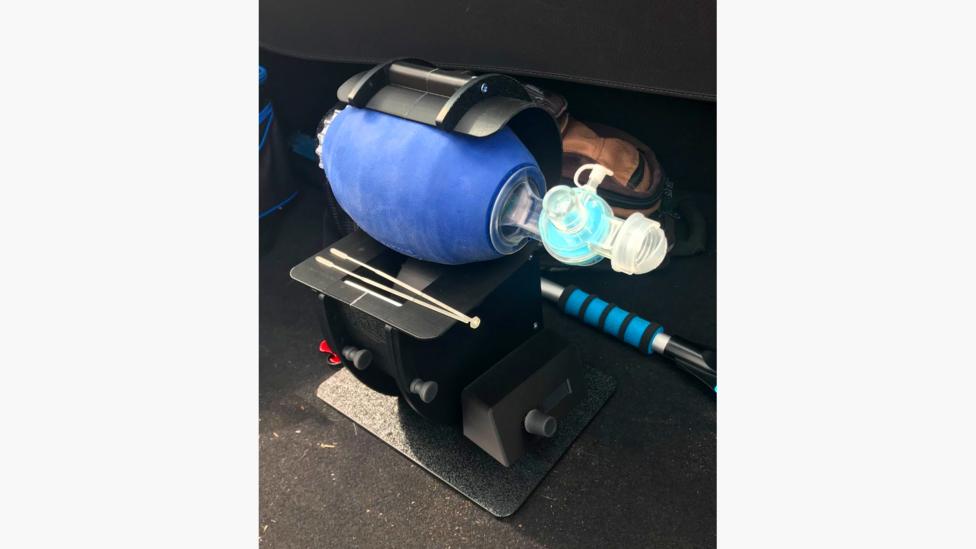
Ambu bag Ventilator gets new life with COVID 19

Many innovators in India are working on this Ambu Bag deign with improvements as an alternate to expensive ventilator. Brief history of this product.
The original bag-valve-mask concept was developed in 1953 by the German doctor Holger Hesse and his partner Danish anesthetist Henning Ruben, following their initial work on a suction pump. Their resuscitator, named “Ambu” (Artificial Manual Breathing Unit), was manufactured and marketed in 1956 by their company.

Ambu Bag
The Danish manufacturer, Testa Laboratory made the first commercially produced Ambu bags in 1957. The company later changed its name to Ambu International. Many other companies now also make self-inflating “bag and mask” resuscitators, like the one shown here. These have become standard equipment in ambulances, hospital emergency rooms, and patient rooms.
A dozen ventilator prototypes at different stages have been developed in March 2020 alone by teams in different countries – and organising on Slack channels, Facebook groups, and GitHub repositories.Some of the most basic open-source ventilator models are based on an ‘ambu-bag’.
The results of this review, however, found that the tested and peer-reviewed ventilator systems lacked complete documentation and that the current open systems that were documented were either at the very early stages of design or had undergone only early and rudimentary testing. With the considerably larger motivation of an ongoing pandemic, it is assumed these projects will garner greater attention and resources to make significant progress to reach a functional and easily replicated open source ventilator system. There is a large amount of technical future work needed to move open source ventilators up to the level considered adequate for scientific-grade equipment and further work still to reach medical-grade hardware. Future work is needed to achieve the potential of this approach not only on the technical side, but also by developing policies, updating regulations and securing funding mechanisms for the development and testing of open source ventilators for both the current COVID19 pandemic, as well as for future pandemics and for everyday use in low-resource settings.

WHO specifications-Products for Surveillance, Prevention & COVID 19

Download specifications:
WHO REFERENCE NUMBER: WHO/2019-nCoV/DCPv3/2020.4

Guide to local production of WHO-recommended Handrub Formulations

Part A is intended to guide a local producer in the actual preparation of the formulation.
Part B contains important safety and cost information and incorporates information from the WHO Guidelines on Hand Hygiene in Health Care (2009).

Friday, April 03, 2020

Expression of Interest (EOI) for Co Developing and manufacturing Devices for COVID-19 Pandemic

Many technologies on offer from SCTIMST: https://www.sctimst.ac.in/COVID-19/
SCTIMST invites manufacturers/start ups/social groups who are interested in working with Institute to co-develop and manufacture medical devices on a fast track mode to support the distressing situation the epidemic COVID 19 has created. Please join us for development and manufacture of devices such as :
  • Ambu bag based Ventilator
  • Ventilator Sharing Kit
  • Battery Operated Assistive Breathing Unit
  • Isolation Pods
  • Disposable Safety Face Shield
  • Deployable Field Units

For further details, please contact Technology Business Division : tbd@sctimst.ac.in
Call us : Mr S. Balram (9249402311)/ Ms Sandhya C.G (9895098086)
License to WIPRO 3D is in news.